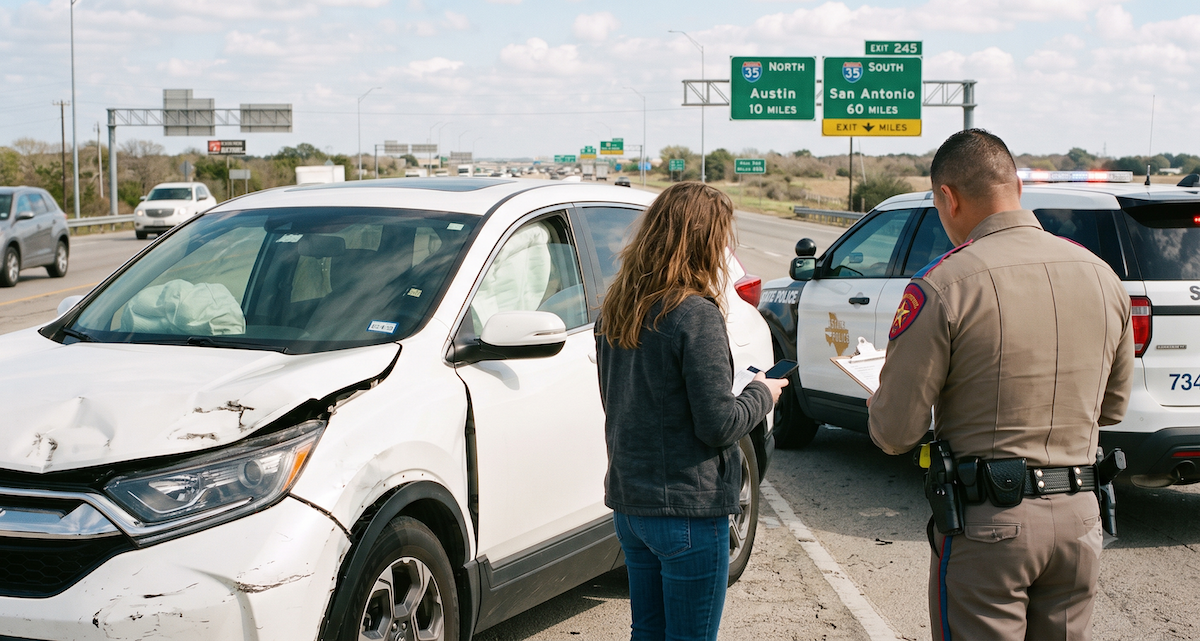
What Happens When You're at Fault in a Serious Texas Car Accident and Your Policy Limit Isn't Enough

Nobody gets behind the wheel expecting to cause a serious accident. But serious accidents happen every day on Texas roads — on crowded Houston freeways, on high-speed Dallas tollways, on the long straight highways that connect Texas cities. And when they do, the financial consequences for the at-fault driver can unfold in ways that most people have never thought through.
Understanding what actually happens after a serious at-fault accident — not in theory, but step by step — is one of the more useful things a Texas driver can do before they ever need to know.
The Moment the Accident Happens
In the immediate aftermath of a serious accident, your focus is on the people involved, the emergency response, and getting through the shock of what just happened. The financial implications begin in the background almost immediately.
Law enforcement arrives and documents the scene. Fault may be assigned at the scene or determined later through investigation. If injuries are serious, ambulances transport the injured. Medical treatment begins.
Your insurer is notified. A claims adjuster is assigned. The process of evaluating the claim begins.
None of this feels financial in the moment. But the clock has started.
What Your Insurance Does First
Your auto liability coverage activates. This is the portion of your policy designed for exactly this situation — covering the injuries and property damage you caused to other people.
Your insurer takes over your legal defense. They assign attorneys to represent you. They communicate with the injured parties and their attorneys. They work toward a settlement or prepare for litigation if one can't be reached.
This is genuinely valuable. Legal defense in a serious personal injury case is expensive — easily $20,000 to $50,000 in attorney fees alone before any settlement is reached, and significantly more if the case goes to trial. Your insurer absorbs that cost as part of your coverage.
Your insurer also negotiates and pays settlements or judgments up to your policy limit. If the total claim is within your liability limits, the process resolves without reaching your personal finances. Your insurer handles it. You move on.
That's the scenario your policy was designed for. It's also not the scenario this article is about.
When the Claim Exceeds Your Limit
Here's where the process changes fundamentally.
Your insurer's obligation ends at your policy limit. If you carry $100,000 per person in bodily injury liability and the injured party's damages total $600,000, your insurer pays $100,000. Then it stops.
The remaining $500,000 is not absorbed by anyone. It doesn't disappear. It becomes a claim against you personally.
At this point, the injured party's attorney — who has been building their case from the moment the accident happened — shifts focus. The insurance money is gone. Now they're coming after you.
What Personal Exposure Actually Looks Like
Texas has some debtor protections that are stronger than many other states. The homestead exemption protects your primary residence from most creditors. Certain retirement accounts carry protection. Tools of trade and some personal property have exemptions.
But these protections are narrower than most people assume — and they don't protect everything.
Investment accounts outside of retirement vehicles are generally reachable. A second property, a vacation home, or rental properties are reachable. Business interests and non-exempt assets are reachable. And wages are subject to garnishment for certain types of judgments in Texas, including personal injury judgments.
More immediately: even assets that are technically protected can be tied up in litigation for years. Legal fees defending a judgment enforcement action cost money regardless of the outcome. The stress, time, and disruption of extended legal proceedings following a serious accident is itself a significant cost that no policy limit calculation captures.
The Timeline Nobody Talks About
One of the most disorienting aspects of a serious at-fault accident is how long the financial consequences persist.
The accident happens in a moment. The legal process that follows can take years.
Personal injury cases in Texas can take 18 months to three years to resolve if they go to litigation. During that time, you're living with the uncertainty of an unresolved claim. Your insurer is managing your defense up to your policy limit — but if it becomes clear that the claim will exceed that limit, your insurer's interests and your personal interests can diverge.
This is a specific and important dynamic worth understanding. Your insurer has an obligation to defend you and to settle claims within your policy limit when possible. But if a reasonable settlement within your limit is available and your insurer declines it — choosing to litigate instead — and a subsequent judgment exceeds your limit, your insurer may bear some responsibility for the excess. This area of insurance law is called bad faith claims handling, and it creates its own complexity.
The simpler point is this: a serious at-fault accident with an inadequate policy limit isn't an event that resolves quickly. It's a process that can occupy years of your life and follow your financial profile for a long time afterward.
The Numbers That Create This Situation
It's worth being specific about what serious injury claims actually cost in Texas — because the gap between typical policy limits and realistic claim values is larger than most drivers appreciate.
A spinal cord injury requiring surgery, hospitalization, and rehabilitation can generate medical costs of $500,000 to $1 million or more. A traumatic brain injury with lasting cognitive effects can produce similar numbers. When long-term care, lost earning capacity over a career, and pain and suffering are factored in, catastrophic injury claims in Texas regularly reach seven figures.
Wrongful death claims — when an at-fault accident kills someone — involve their own calculus. The lost income of a working adult over a career, combined with loss of companionship claims from surviving family members, can generate judgments well into the millions.
Texas juries in serious personal injury cases have historically been willing to return substantial verdicts. The state's major metro areas — particularly Harris County and Dallas County — have produced some of the largest personal injury verdicts in the country.
A driver carrying $100,000 per person in bodily injury liability — a common coverage level in Texas — is one serious accident away from a personal financial exposure that dwarfs that limit.
What Changes This Outcome
There are two levers that determine whether a serious at-fault accident becomes a personal financial catastrophe or remains a contained insurance event.
Higher underlying liability limits. Moving from $100,000 per person to $250,000 or $300,000 in bodily injury liability adds meaningful protection and costs a fraction of what most drivers expect. It doesn't eliminate the gap on a catastrophic claim, but it reduces the personal exposure significantly and covers a much larger percentage of realistic claim scenarios.
Umbrella insurance. A $1 million umbrella policy adds a layer of coverage above your auto liability limits that activates when those limits are exhausted. In the scenario above — a $600,000 claim against a $100,000 auto policy — an umbrella policy covers the $500,000 gap up to its own limit. Your insurer keeps paying. Your personal assets stay out of reach.
The combined cost of higher underlying limits and a $1 million umbrella policy for most Texas households is $300 to $500 per year. Measured against the scenario this article describes, that math resolves quickly.
The Driver Who Didn't Think It Would Happen to Them
There's a reason serious at-fault accidents catch people financially unprepared even when they've thought vaguely about insurance coverage.
The risk feels abstract until it's not. Every driver who has ever caused a serious accident was, before that moment, someone who had never caused a serious accident. The transition from one category to the other takes a second.
Texas roads make the exposure higher than many drivers internalize. High speeds, heavy commercial traffic, long driving distances, distracted driving, and a large population of uninsured drivers all contribute to an environment where serious accidents happen with sobering regularity.
The drivers who come through a serious at-fault accident with their financial lives intact aren't the ones who were luckier or more careful. They're the ones who had structured their coverage to handle the realistic worst case — not just the manageable middle.
A Final Thought
Auto insurance exists for exactly this situation. The question isn't whether you need it — you do, and Texas law requires it. The question is whether the coverage you're carrying is sized for the risk you're actually carrying every time you drive.
Most Texas drivers are underinsured relative to that risk. Not recklessly so — just insufficiently so. The gap between a standard policy limit and the cost of a serious injury claim in Texas is real, it's large, and it's the kind of thing that becomes very clear very fast after an accident that nobody saw coming.
Closing that gap costs less than most people expect. And it's considerably easier to do before an accident than after one.
For educational purposes only. Consult a licensed Texas insurance agent for guidance specific to your situation.
Find out exactly what you're missing.
The free 4-minute checkup identifies your gaps and matches you with a local independent advisor.
Free Coverage Review →