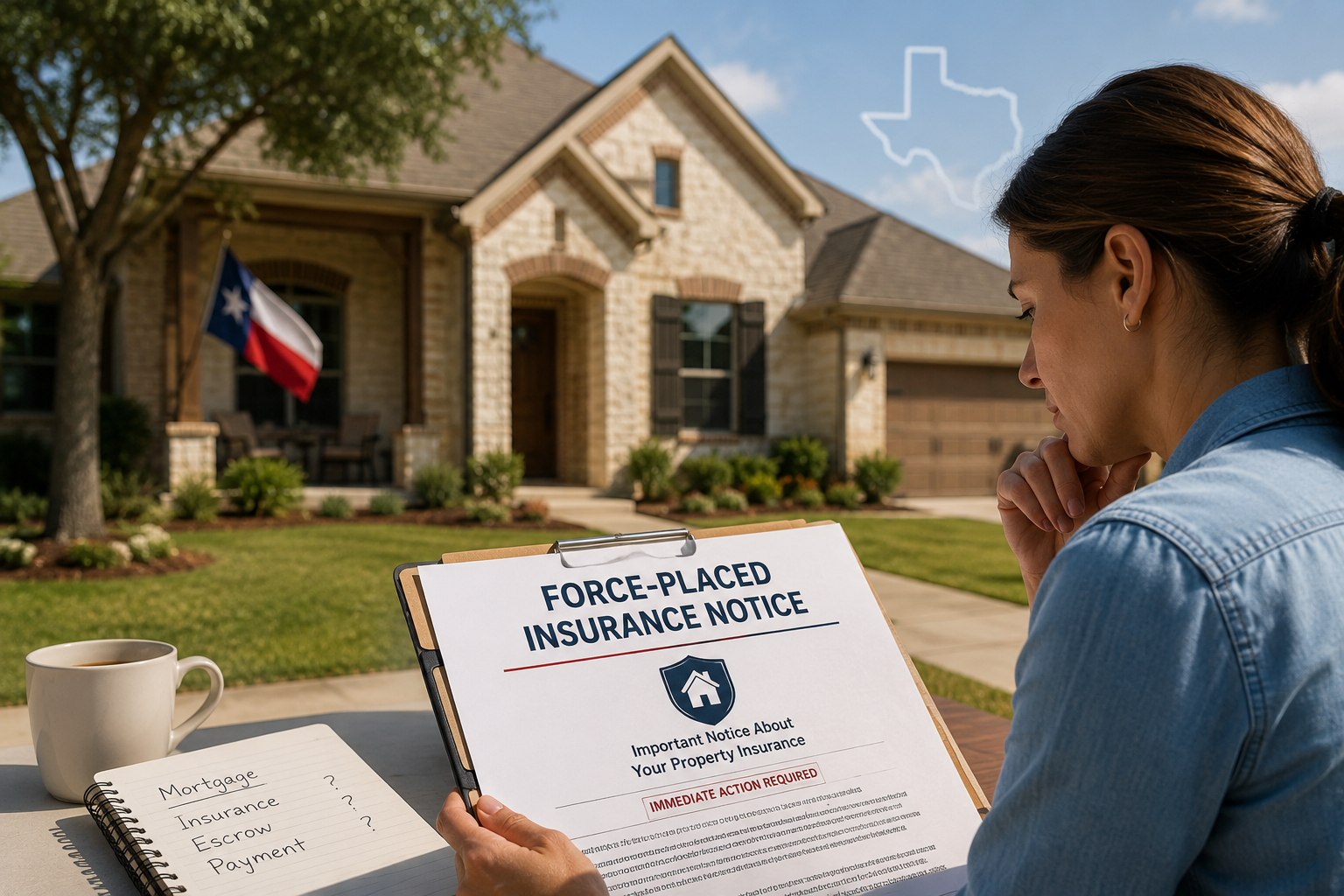
How to Lower Your Home Insurance in Texas: What Actually Works
Texas homeowners insurance has gotten more expensive in recent years.
Severe weather losses, rising construction costs, reinsurance pressures, and a tightening carrier market have pushed premiums higher across the state — and many homeowners are paying more than necessary because they haven't actively managed their coverage.
Some approaches to lowering your home insurance premium work well. Others are marginal. Here's an honest breakdown.
Shop Your Coverage — Every Renewal
The most effective single action most Texas homeowners can take is comparing rates across multiple carriers at every renewal.
The homeowners insurance market in Texas is not static.
Carrier pricing shifts.
New carriers enter markets.
Existing carriers adjust their appetites for certain property types, locations, or risk profiles.
A carrier that was the best available option for your home three years ago may be meaningfully more expensive today — and a carrier that wasn't competitive then may now offer significantly better terms.
Homeowners who accept their renewal premium without shopping are, on average, paying more than those who compare rates actively.
The difference can be substantial — sometimes hundreds of dollars per year for comparable coverage.
An independent agent is the most efficient way to shop.
They access multiple carriers simultaneously rather than requiring you to call each one individually, and they know which carriers are currently competitive for your specific property profile in your specific Texas location.
Bundle Home and Auto
Combining your homeowners and auto insurance with the same carrier typically produces discounts of 10% to 20% on both policies.
For most Texas households, this is one of the most straightforward discounts available — and one of the most consistently valuable.
If your home and auto are currently with different carriers, get a bundled quote from each carrier you're considering.
The bundled discount needs to be weighed against the underlying rates for both policies — sometimes the bundled rate at one carrier is still higher than separate policies at two different carriers.
Run the actual numbers before assuming bundling always wins.
Raise Your Deductible Deliberately
Increasing your homeowners deductible reduces your premium.
The relationship is direct — a higher deductible means lower monthly or annual cost.
The important nuance in Texas is that homeowners policies often have two separate deductibles: a standard deductible for most claims and a separate wind and hail deductible that applies specifically to those perils.
The wind and hail deductible is typically expressed as a percentage of your dwelling coverage — not a flat dollar amount.
On a $400,000 home with a 2% wind and hail deductible, your out-of-pocket cost on a hail claim is $8,000 before coverage applies.
A 1% deductible cuts that to $4,000 but increases your annual premium.
The right choice depends on your savings, your hail risk by location, and how often you'd realistically file a hail claim.
Raising your standard deductible — for non-weather claims — typically produces more modest premium savings than raising the wind and hail deductible in Texas, simply because weather claims dominate the loss landscape here.
Before raising any deductible, confirm you could comfortably pay the new amount from savings without financial disruption.
Make Targeted Home Improvements
Certain property improvements reduce the risk your home represents to insurers — and some carriers reward those improvements with premium discounts.
New roof. A roof replacement is the single improvement most likely to produce meaningful premium savings in Texas.
A new roof reduces the carrier's expected claim cost significantly and often opens access to better coverage terms and lower premiums.
Carriers typically want documentation — permits, contractor receipts — to verify the replacement date.
Impact-resistant roofing materials.
Texas carriers often offer discounts for roofs made from Class 4 impact-resistant materials — designed to withstand hail better than standard asphalt shingles.
The discount varies by carrier but can be meaningful in high-hail areas.
Given Texas's hail frequency, the insurance savings over time can contribute to offsetting the higher upfront cost of impact-resistant materials.
Updated electrical, plumbing, and HVAC systems.
Homes with older systems face higher premiums in some markets because aging systems represent elevated fire and water damage risk.
Updating these systems — particularly older knob-and-tube wiring or galvanized plumbing — can improve your insurability and sometimes your rate.
Security systems and monitoring.
Most Texas carriers offer discounts for homes with monitored security systems — typically 5% to 10%.
Smoke detectors, deadbolt locks, and fire extinguishers may produce smaller additional discounts.
The monitoring requirement — as opposed to an unmonitored alarm — is typically necessary for the larger discount.
Storm shutters and reinforced doors.
In coastal and wind-exposed areas, storm-resistant features may qualify for discounts with certain carriers.
The availability varies more by carrier and location than other improvements.
Review Your Coverage Amount Annually
Homeowners policies cover your dwelling up to a stated amount.
If your coverage amount is higher than necessary to rebuild your home, you're paying premiums on coverage you couldn't use.
This is less common than the opposite problem — being underinsured — but it occurs when coverage amounts haven't been recalibrated as construction costs or property values change.
An insurance-to-value assessment from your agent can identify whether your coverage amount is appropriately sized.
More commonly, Texas homeowners are underinsured — their dwelling coverage hasn't kept pace with rising construction costs.
This creates a different problem at claim time but doesn't affect premiums in the direction of reducing them.
Don't Over-Insure Personal Property
Standard homeowners policies cover personal property — furniture, clothing, electronics, appliances — at a percentage of dwelling coverage, typically 50% to 70%.
For many households, this percentage generates a personal property coverage amount well above what the household's actual possessions are worth.
Reviewing your personal property coverage and reducing it to a realistic replacement value for your actual belongings can reduce your premium modestly.
This requires actually estimating what your belongings would cost to replace — a home inventory is the most accurate approach.
Be Thoughtful About Small Claims
Every claim you file appears on your insurance record through the CLUE database.
Multiple claims within a short period can trigger rate increases or non-renewal, even for weather-related claims outside your control.
Claims below or modestly above your deductible are often not worth filing from a pure cost-benefit standpoint. If a hailstorm causes $1,500 in damage and your deductible is $1,000, filing a claim nets you $500 in coverage while potentially triggering a premium increase worth more than that over the following years.
The decision to file a claim should include an honest assessment of whether the net coverage received justifies the potential rate impact.
For large claims — significant roof damage, a major water loss, fire damage — the answer is almost always yes.
For small claims close to your deductible, the calculus is less clear.
Ask About Every Available Discount
Homeowners insurance carriers offer various discounts that aren't always automatically applied. Asking explicitly whether you're receiving every discount you qualify for is worth a five-minute conversation with your agent.
Common Texas homeowners discounts include: new home discount for recently constructed properties, loyalty discount for long-term policyholders at some carriers, gated community discount, fire station proximity discount for homes near a fire station with a hydrant, non-smoker discount at some carriers, and claims-free discount for policyholders with no recent claims history.
A Final Thought
Texas homeowners insurance isn't cheap, and the underlying cost drivers — weather risk, construction costs, reinsurance pricing — aren't fully within your control.
What is within your control is whether you're paying the most competitive available rate for your property profile, using every available discount, and structuring your deductibles and coverage amounts deliberately.
Active management of your homeowners insurance — shopping at renewal, improving your property strategically, maintaining a clean claims record — consistently produces better outcomes than passive acceptance of whatever renewal arrives in the mail.
For educational purposes only. Coverage terms and availability vary by insurer and individual circumstances. Consult a licensed Texas insurance agent for guidance specific to your situation.
Find out exactly what you're missing.
The free 4-minute checkup identifies your gaps and matches you with a local independent advisor.
Free Coverage Review →