How to Read Your Texas Homeowners Insurance Declarations Page
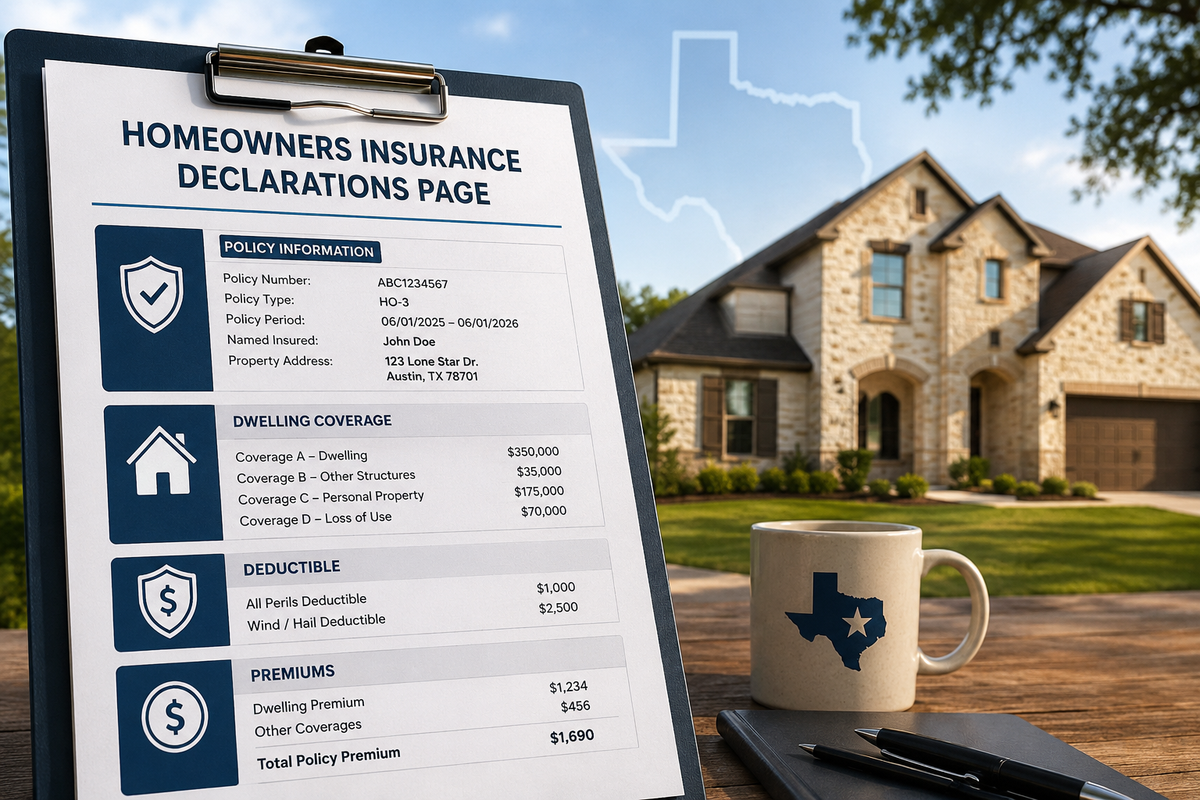
Your homeowners insurance declarations page — the "dec page" in industry shorthand — is the summary document at the front of your policy. It fits on one or two pages and contains the most important information about your coverage: what you're covered for, how much, and at what cost.
Most Texas homeowners glance at the premium number and file the rest. Here's what the other sections actually tell you.
Policy Information
The top section of your declarations page identifies the basics: your policy number, the insured name and address, the policy period (effective and expiration dates), and your insurance company's name and contact information.
What to verify: Make sure your name is spelled correctly and your property address is accurate. Errors here can complicate claims. Also confirm the policy period — your coverage starts and ends on the dates shown, and there's no grace period after the expiration date.
Coverage Amounts
This section is the most important on the page. It lists the coverage limits for each major coverage category.
Coverage A — Dwelling. The maximum your insurer will pay to repair or rebuild your home's structure. This should reflect the current cost to rebuild your home — not its market value, and not what you paid for it. If this number hasn't been updated in several years, it may not keep pace with current Texas construction costs.
Coverage B — Other Structures. Coverage for structures on your property that aren't the main dwelling — fences, detached garages, sheds, guesthouses. Typically set at 10% of Coverage A.
Coverage C — Personal Property. The maximum your insurer pays for your personal belongings.
Typically 50% to 70% of Coverage A. Confirm whether this is replacement cost or actual cash value — the method isn't always obvious from the dec page alone.
Coverage D — Additional Living Expenses. The maximum your insurer pays for temporary housing and increased living costs if your home is uninhabitable after a covered loss. Typically 20% to 30% of Coverage A. Know this number in dollar terms — not just as a percentage.
Coverage E — Personal Liability. The maximum your insurer pays if you're found legally responsible for injuries or property damage to others. $100,000 is common as a default. This number deserves specific attention — for many Texas homeowners with significant assets, it's inadequate.
Coverage F — Medical Payments. Pays medical expenses for guests injured on your property, regardless of fault. Typically $1,000 to $5,000 — a relatively small amount designed for minor incidents.
Deductibles
Your deductible section shows what you pay out of pocket before coverage applies. In Texas, this section often shows multiple deductibles.
All-peril deductible. The standard deductible for most covered claims — fire, theft, vandalism, and similar events. This is often a flat dollar amount.
Wind and hail deductible. Frequently a separate, higher deductible for wind and hail claims specifically. In Texas, this is almost always expressed as a percentage of Coverage A rather than a flat dollar amount. A 2% wind/hail deductible on a $400,000 Coverage A is $8,000 out of pocket on any wind or hail claim.
If your declarations page shows a wind/hail deductible as a percentage, calculate the dollar amount and make sure you know what it is. This number surprises more Texas homeowners at claim time than almost any other coverage detail.
Premium
The premium section shows what you pay — broken down by coverage component in some policies, shown as a single total in others. It may also show credits for discounts applied to your policy.
If discounts are shown, review them. Are you receiving every discount you qualify for? Good home discounts, protective device discounts, claims-free discounts, and bundling discounts should all appear here if applicable.
Mortgagee Information
If you have a mortgage, your lender is listed here as an additional interested party. This section directs claim payments — for a dwelling claim, your insurer pays your lender first if there's a mortgage on the property.
Verify your lender's information is current. If you've refinanced or your loan has been sold to a new servicer, update your insurer to ensure the correct lender is listed.
Endorsements
Endorsements are modifications to the standard policy — additions, restrictions, or clarifications. Your declarations page typically lists active endorsements.
Common endorsements in Texas homeowners policies include: scheduled personal property (floaters for high-value items), service line coverage, equipment breakdown coverage, ordinance or law coverage, and water backup coverage.
Review the endorsement list and confirm you understand what each one does. If there are endorsements you don't recognize, ask your agent to explain them.
What to Do After Reading It
After reviewing your declarations page, note anything that warrants a follow-up conversation with your agent.
Is your Coverage A adequate for current rebuild costs? Is your wind/hail deductible what you expected in dollar terms? Is your personal liability limit adequate for your assets?
Is your personal property covered on replacement cost? Are you receiving every applicable discount?
Those questions, answered with current information, tell you whether your coverage still makes sense or whether adjustments are worth making at your next renewal.
For educational purposes only. Consult a licensed Texas insurance agent for guidance specific to your situation.
Find out exactly what you're missing.
The free 4-minute checkup identifies your gaps and matches you with a local independent advisor.
Free Coverage Review →