How to Lower Your Car Insurance: What Actually Works

Car insurance premiums have risen significantly in recent years. Drivers who haven't actively managed their coverage are often paying more than necessary — not because good options don't exist, but because the default is to accept the renewal number without scrutinizing it.
Some approaches to lowering your auto insurance rate work well. Others are marginal. Here's an honest breakdown of what actually makes a difference.
Shop Your Coverage at Every Renewal
This is the single most impactful action most drivers can take — and the one most consistently skipped.
Auto insurance pricing varies significantly across carriers for identical risk profiles. An insurer that was competitive for your profile two years ago may not be today. Carriers adjust their pricing models, enter and exit markets, and shift their appetite for specific risk profiles constantly. What was the best available rate when you last shopped may no longer be.
The drivers who consistently pay competitive rates are the ones who shop at every renewal — not just when something prompts them to. A 20-minute comparison process at renewal produces meaningfully better outcomes than years of loyalty to a carrier that has quietly become uncompetitive.
Working with an independent agent accelerates this process. An independent agent shops multiple carriers simultaneously and knows which ones are currently competitive for your specific profile — including your driving record, your location, your vehicles, and your coverage needs. That knowledge saves time and produces better results than calling carriers individually.
Use Every Discount You Qualify For
Most carriers offer a range of discounts that are available but not always automatically applied. Asking explicitly whether you're receiving every discount you qualify for is a straightforward way to find money left on the table.
Multi-policy discount. Bundling your auto and homeowners or renters insurance with the same carrier typically produces discounts of 10% to 20% on both policies. If your auto and home coverage are with different carriers, get a bundled quote to see whether the discount offsets any difference in underlying rates.
Good driver discount. A clean driving record — typically three to five years without at-fault accidents or moving violations — qualifies you for a good driver discount with most carriers. If your record is clean and you're not receiving this discount, ask.
Good student discount. Teen and young adult drivers on your policy who maintain a B average or better qualify for discounts of 5% to 15% with most carriers. Documentation is required and isn't always collected automatically at renewal.
Low mileage discount. If your driving patterns changed — remote work, a shorter commute, retirement — and you're driving significantly fewer miles than when your policy was written, a low mileage discount may be available.
Telematics or usage-based discount. Many carriers offer programs that track driving behavior through a mobile app or device and reward safe driving habits with premium discounts. For drivers who brake smoothly, avoid hard acceleration, don't use their phone while driving, and avoid late-night driving, these programs can produce meaningful discounts — sometimes 10% to 30% off standard rates.
Vehicle safety features. Anti-lock brakes, automatic emergency braking, lane departure warning, and other safety features qualify for discounts with many carriers. If your vehicle has advanced safety technology and your insurer isn't discounting for it, ask.
Paid-in-full discount. Paying your annual premium in full rather than in monthly installments typically saves 5% to 10% with most carriers. If your premium is manageable as a lump sum, the discount is straightforward value.
Paperless and autopay discounts. Modest but real — most carriers offer small discounts for electronic statements and automatic payment enrollment.
Alumni and professional association discounts. Many carriers offer discounts through employer groups, alumni associations, professional organizations, and membership clubs. Check whether any organizations you belong to offer group auto insurance rates.
Raise Your Deductible Deliberately
Increasing your collision and comprehensive deductibles is one of the most direct ways to reduce your premium. Higher deductibles mean lower premiums because you're absorbing more of the financial risk per claim.
The key word is deliberately. A deductible is only useful if you can comfortably pay it when a claim happens. Raising your deductible from $500 to $1,500 to save $20 per month is a poor tradeoff if something happens and you don't have $1,500 liquid.
Before raising your deductible, confirm that the new amount is genuinely accessible from savings without financial stress. Then calculate the break-even period — divide the additional out-of-pocket risk by the annual premium savings. If the break-even is two years or less and you're unlikely to file a claim in that window, a higher deductible often makes sense.
Review Your Coverage on Older Vehicles
Collision coverage on a vehicle with low market value may not make financial sense. If your vehicle is worth $5,000 or less, the annual collision premium plus your deductible can approach or exceed the maximum you'd receive in a claim.
The calculation is straightforward: what is your vehicle's current market value? What is your annual collision premium? What is your deductible? If the premium plus deductible approaches the vehicle's value, you're paying for protection that can't pay out more than you've spent.
Dropping collision on a low-value paid-off vehicle eliminates that coverage and the associated premium. It means accepting the risk of vehicle damage after an at-fault accident — which is the right tradeoff for vehicles where the collision coverage provides limited value.
Comprehensive coverage is a separate calculation. Even on a lower-value vehicle, comprehensive at a modest annual premium may still make sense — it covers theft, weather damage, and other non-collision events that collision coverage doesn't touch.
Protect Your Driving Record
Your driving record is one of the most influential factors in your auto insurance premium — and one of the few you have direct ongoing control over.
An at-fault accident typically raises premiums 20% to 40% and follows your record for three to five years depending on your carrier and state. A DUI or DWI can double premiums or more and may persist even longer. Multiple moving violations accumulate into significant rate increases.
The insurance cost of a single serious incident — measured in elevated premiums over three to five years — often exceeds the cost of the incident itself. In many cases, paying out of pocket for minor damage is less expensive over time than filing a claim that affects your record and triggers a rate increase.
For drivers who've had a recent violation, many states allow completion of a state-approved defensive driving course to dismiss a qualifying ticket and prevent points from being assessed. If you've received a moving violation recently, ask the court and your insurer whether defensive driving is available.
Improve Your Credit Score
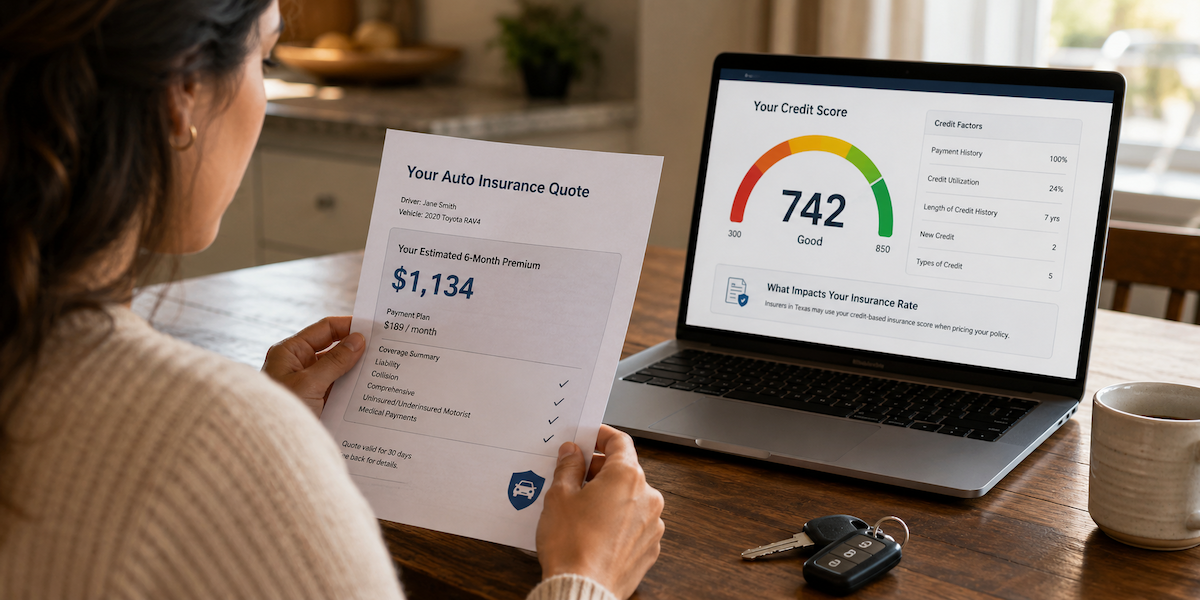
In most states, auto insurers use credit-based insurance scores as a rating factor. Drivers with better credit scores pay lower premiums — often significantly lower — than drivers with poor credit for otherwise identical coverage.
The spread between the best and worst credit tiers can be 50% or more at many carriers. Improving your credit score over time produces real premium reductions at each renewal.
The actions that improve your credit for insurance purposes are the same ones that improve it for any financial purpose: paying bills on time consistently, reducing credit card balances, disputing errors on your credit report, and avoiding unnecessary new credit inquiries.
Credit improvement is a long-term lever — the benefits appear gradually over months and years. But for drivers who are working on credit improvement for other financial reasons, the auto insurance benefit compounds at every renewal.
Consider Your Vehicle Before You Buy
The vehicle you drive significantly affects your premium — and most buyers don't factor insurance cost into vehicle purchase decisions until after they've committed.
Vehicles that cost more to repair, that are more frequently stolen, or that have poor safety ratings generate higher premiums. Vehicles that hold their value, have strong safety ratings, and are inexpensive to repair generate lower premiums.
Before purchasing a vehicle, getting an insurance quote for that specific make, model, and trim is a 15-minute step that can reveal significant premium differences between vehicles that seem similarly priced at the lot. The vehicle that costs $3,000 more at purchase but saves $600 per year in insurance may be the better financial decision — or the reverse may be true. Running the actual numbers produces better decisions than guessing.
Reassess Your Coverage Needs Periodically
Coverage that made sense when you bought your policy may no longer make sense today. Life changes — and so do the coverage needs that follow from it.
A vehicle you're still paying off requires full coverage because your lender demands it. A vehicle that's been paid off for years and has depreciated significantly may not warrant the same coverage level.
A teen driver who has been on your policy for several years and now has their own vehicle should probably be removed. A spouse who was on your policy and is no longer in the household needs to be addressed.
A coverage review — not just a renewal acceptance — once per year ensures your policy reflects your actual current situation rather than a snapshot of your life from three years ago.
What Doesn't Work as Well as Advertised
Calling your current insurer and asking for a lower rate without shopping first. Your insurer has limited incentive to reduce your rate without competitive pressure. Asking them to lower your premium without competitive quotes to reference rarely produces meaningful results.
Reducing liability coverage to minimum levels. The premium savings from minimum liability limits are often modest, and the financial exposure they create is significant. This is the coverage reduction that looks like savings and creates the most risk. Liability limits protect your personal assets — your savings, your home equity, your wages — when you cause a serious accident. Reducing them to save $15 per month is rarely the right tradeoff.
Switching carriers for a promotional rate without reading the terms. Some carriers offer introductory rates that increase significantly at the first renewal. Read the terms of any new policy carefully before switching.
Making small claims. Filing a claim for an amount modestly above your deductible can trigger a rate increase at renewal worth more than the claim paid over several years. Before filing any claim, consider whether the net benefit — the claim amount minus your deductible — justifies the likely rate impact. For small claims, paying out of pocket and preserving your claims-free discount is often the better financial decision.
A Final Thought
The drivers paying the most competitive auto insurance rates aren't the luckiest — they're the most active. They shop at renewal. They maintain clean records. They use every available discount. They structure their deductibles deliberately. And they review their coverage periodically to make sure it still fits their life.
None of that requires extraordinary effort. It requires treating your auto insurance renewal as a financial decision worth 30 minutes of attention — rather than a bill to accept and pay.
For educational purposes only. Coverage terms, discount availability, and pricing vary by insurer, state, and individual circumstances. Consult a licensed insurance agent for guidance specific to your situation.
Find out exactly what you're missing.
The free 4-minute checkup identifies your gaps and matches you with a local independent advisor.
Free Coverage Review →