The $300-a-Year Policy That Could Save Your Life Savings — and Why Most Texans Don't Have It

There is an insurance product that costs most Texas households somewhere between $150 and $300 per year, provides $1 million or more in liability protection, and is owned by a small fraction of the people who would genuinely benefit from it.
It doesn't have a compelling name. It isn't marketed aggressively. Most insurance agents mention it briefly at the end of a conversation about auto or home coverage and move on. And most people nod politely and decline.
That product is umbrella insurance. And for a meaningful number of Texas families, not having it is one of the more consequential financial oversights they're making.
Why Most People Don't Have It
The honest reason most Texans don't carry umbrella insurance isn't cost. At $150 to $300 per year, cost is rarely the real barrier.
The reason is that nobody has ever made the case for it in a way that felt personal and concrete. It gets described as a vague extra layer of protection. It gets mentioned in passing. It gets filed away as something to think about later.
Later rarely comes.
The other reason is psychological. Umbrella insurance protects against low-probability events — serious accidents, significant lawsuits, judgments that exceed standard policy limits. Human beings are not naturally good at valuing protection against things that feel unlikely. We pay for the risks we've already experienced or that feel immediately real. A fender bender feels real. A seven-figure lawsuit feels abstract.
Until it isn't.
How Liability Coverage Actually Works
To understand what umbrella insurance does, it helps to understand the structure it sits on top of.
Your auto insurance policy includes liability coverage — the portion that pays for injuries and damage you cause to other people in an accident you're responsible for. A typical Texas auto policy might carry $100,000 per person in bodily injury liability, $300,000 per accident total.
Your homeowners insurance includes personal liability coverage — the portion that pays if someone is injured on your property or you're found responsible for damage to someone else's property. A typical homeowners policy might carry $300,000 in personal liability.
These limits represent the maximum your insurer will pay. When a claim exceeds them, your insurer pays its limit and stops. The remainder is your personal financial responsibility — payable from your savings, your home equity, your investment accounts, your future wages.
An umbrella policy adds a layer above those limits. When your auto or home policy is exhausted, the umbrella activates and covers the excess up to its own limit — typically $1 million, $2 million, or more. Your insurer keeps paying. Your personal assets stay protected.
What a Real Claim Looks Like
This is where abstract concepts become concrete.
A Texas family is driving home on a Saturday afternoon. The driver is distracted for a moment — a phone notification, a child in the back seat, a split second of inattention — and rear-ends a vehicle at highway speed. The other vehicle carries two occupants. Both are seriously injured.
One sustains a spinal injury requiring surgery, extended rehabilitation, and permanent modifications to their daily life and work capacity. The claim that follows includes emergency care, surgery, hospitalization, physical therapy, lost wages over a career, pain and suffering, and attorney fees. Total damages reach $1.4 million.
The at-fault driver's auto policy has $300,000 in bodily injury liability per accident. The insurer pays $300,000 and closes the file. The remaining $1.1 million is a judgment against the driver personally. Without an umbrella policy, that judgment reaches everything the driver has built. Home equity.
Retirement savings. Investment accounts. Future wages through garnishment. In Texas, homestead protections shield the primary residence from many creditors — but retirement accounts, non-homestead property, and other assets carry less protection than many people assume.
With a $1 million umbrella policy, the insurer pays an additional $1 million. The driver's personal exposure drops from $1.1 million to $100,000 — still significant, but manageable in a way the alternative is not.
The umbrella policy cost that family roughly $200 per year.
The Scenarios That Create This Exposure
Serious auto accidents are the most common source of umbrella-level liability claims. But they're not the only one.
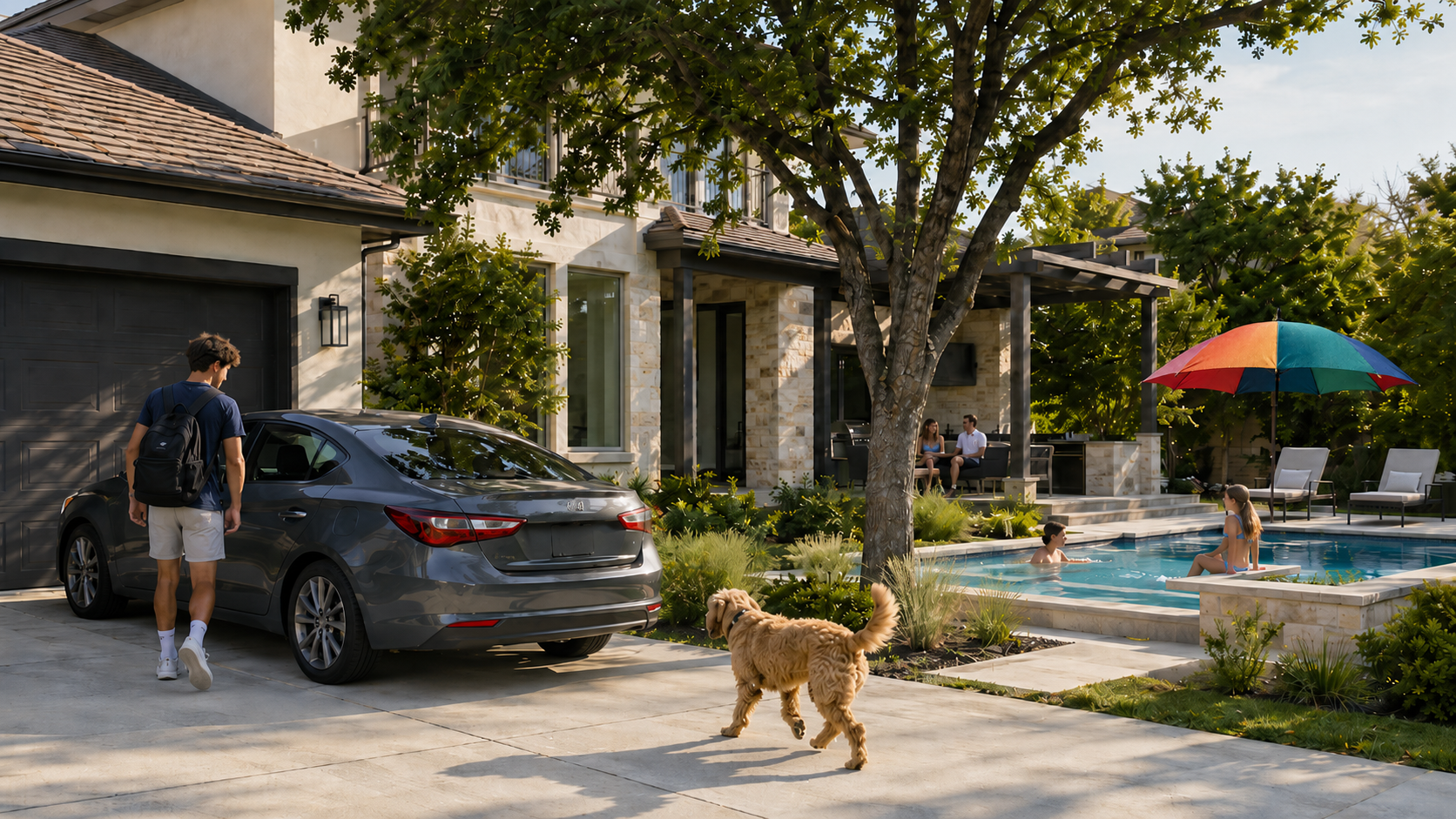
A guest is seriously injured at your home. A backyard gathering, a pool party, a holiday get-together — any event where people are on your property creates liability exposure. A guest who sustains a serious injury can bring a claim that quickly exceeds a standard homeowners liability limit.
Your dog bites someone. Texas follows a one-bite rule with nuance — if your dog has shown prior aggression, you can be held strictly liable for subsequent bites. A serious dog bite resulting in disfigurement, scarring, or nerve damage can generate a claim well beyond what a homeowners policy covers.
Your teenager causes a serious accident. Teen drivers are statistically the highest-risk drivers on the road. An at-fault accident involving a teen driver in your household runs through your auto policy first. When it exceeds those limits — which serious accidents involving teen drivers do with uncomfortable frequency — the excess reaches you personally. Umbrella coverage is particularly valuable for households with newly licensed drivers.
Your swimming pool is involved in an injury. Pools are considered attractive nuisances under Texas law — meaning you can be held liable for injuries to children who access your pool without permission, in addition to injuries to invited guests. Pool-related injury claims can be substantial.
A social media post generates a defamation claim. Umbrella policies often cover personal injury claims including libel and slander. In an environment where public statements carry real legal risk, this coverage has become more relevant than it was a generation ago.
What It Actually Costs
A $1 million umbrella policy for a typical Texas household — two adults, two vehicles, a home, no teen drivers — costs approximately $150 to $250 per year.
Adding a teen driver to the household pushes that number higher, typically into the $250 to $400 range. A swimming pool adds a modest increment. Multiple properties, certain dog breeds, and prior claims history all factor in.
Even at the high end of that range, the math is straightforward. $400 per year is $33 per month for $1 million in additional liability protection. For $2 million in coverage, add roughly $75 to $100 per year. Each additional million above that typically adds $50 to $100 annually.
These are among the most cost-efficient insurance products available to individual consumers.
The reason umbrella coverage is relatively inexpensive is that it activates only after substantial underlying coverage is exhausted — a low-frequency event that insurers can price efficiently.
What You Need Before You Can Buy It
Umbrella policies require minimum liability limits on your underlying auto and home policies.
Most insurers require at least $250,000 to $300,000 in auto bodily injury liability and $300,000 in homeowners personal liability before they'll write an umbrella policy on top.
If your current limits are below those thresholds, you'll need to raise them first. That adds a modest cost — but the combined expense of higher underlying limits plus an umbrella policy typically remains well under $500 per year for most Texas households.
Most umbrella policies are written by the same carrier that holds your home and auto coverage.
Bundling all three with one insurer often produces a discount across all of them, partially or fully offsetting the umbrella premium.
Who Needs It Most
Umbrella insurance protects what you have. The more you have, the more there is to protect — and the more a judgment against you can reach.
The case for umbrella coverage becomes particularly compelling when one or more of the following apply to your household: meaningful home equity, retirement savings or investment accounts, a teenager with a driver's license, a swimming pool, a dog, rental property, frequent driving or long commutes, regular gatherings at your home, or a public profile that creates defamation exposure.
If your net worth is modest and your assets are limited, the financial exposure from an uninsured judgment is real but bounded. As assets accumulate — as equity builds, as savings grow, as retirement accounts compound — the gap that an uninsured judgment could reach grows with them.
The right time to buy umbrella insurance is before the event that would have made you wish you had it. That's a tautology, but it's the accurate one.
A Final Thought
Most financial decisions involve real tradeoffs. Saving more means spending less. Investing aggressively means accepting volatility. Paying down debt means forgoing other uses of that money.
Umbrella insurance at $150 to $300 per year doesn't feel like a real tradeoff for most Texas households with meaningful assets. The cost is modest. The protection is substantial. The alternative — absorbing a judgment that exceeds your standard policy limits from personal savings — is one of the more efficient ways a financially stable family can find themselves in serious trouble.
It's not a product that comes up in conversation often. It doesn't generate urgency the way a renewal notice does. It sits quietly in the background of a well-structured financial life, doing nothing — until the one moment it does everything.
That's exactly what good insurance is supposed to do.
For educational purposes only. Coverage terms, availability, and pricing vary by insurer and individual circumstances. Consult a licensed Texas insurance agent for guidance specific to your situation.
Find out exactly what you're missing.
The free 4-minute checkup identifies your gaps and matches you with a local independent advisor.
Free Coverage Review →